AI Labeling in 2026: What Applies to Ads and Chatbots
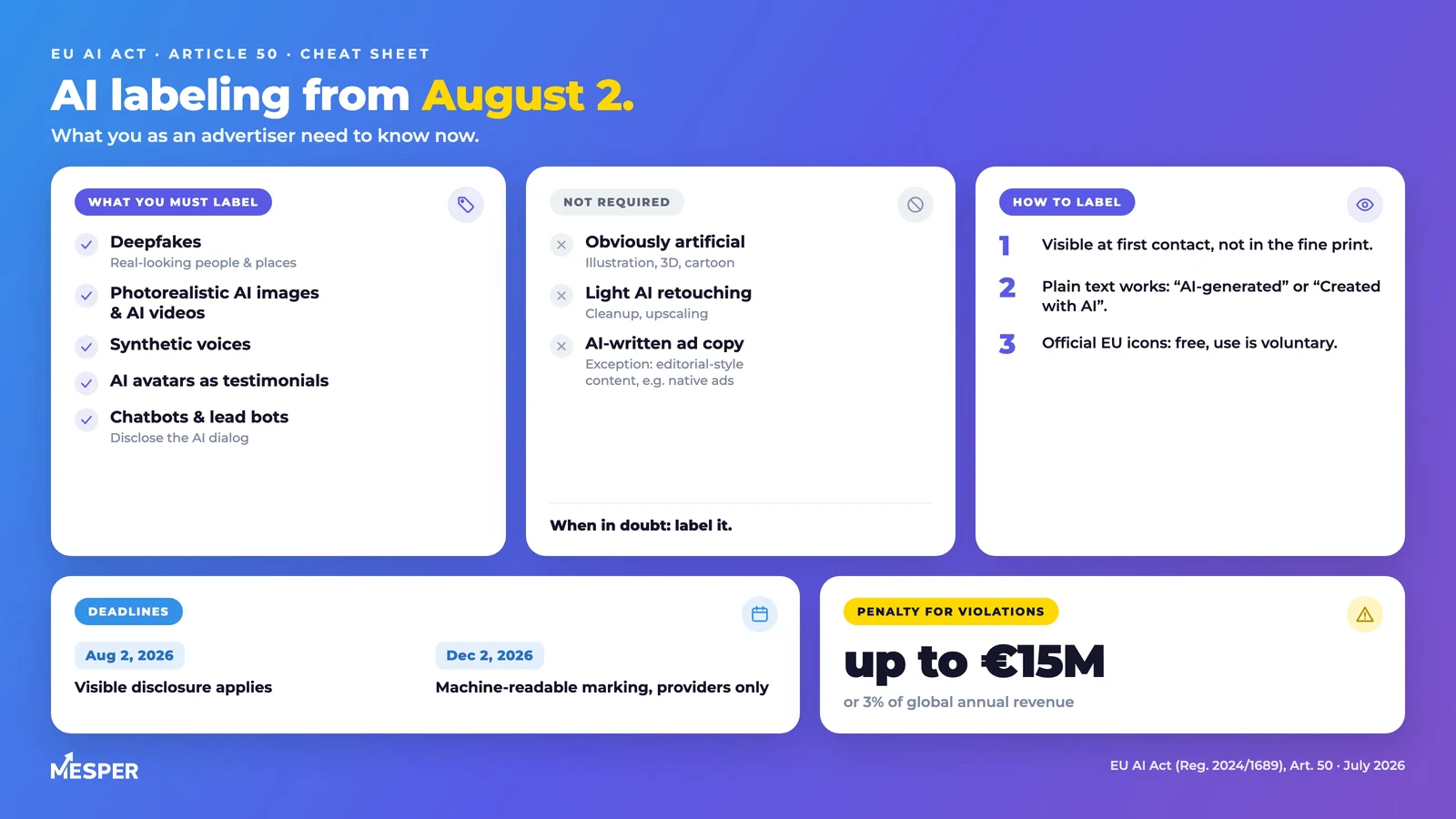

Article 50 of the EU AI Act applies since August 2, 2026. It does not impose a blanket visible label on every ad made with AI. Brands need to ask three separate questions: Is the creative a deepfake? Does the AI text inform the public on a matter of public interest? Is someone interacting directly with an AI system?
Updated: September 16, 2026. This guide explains the rules for creative and marketing teams. It draws on Article 50 and the European Commission guidelines.
Which obligation belongs to whom
- AI tool providers: Providers of generative AI systems generally need to mark synthetic outputs in a machine-readable format and make them detectable. Technical marking is separate from a visible notice in an ad.
- Brands and agencies: Professional users of AI must disclose deepfakes and certain AI text publications. The assessment depends on the actual content and its context.
- Direct AI interaction: Providers must design systems so people are informed when they interact with AI, unless this is obvious. For your website chatbot, check your supplier's implementation too.
When a creative is a deepfake
A deepfake is AI-generated or manipulated image, audio or video that resembles persons, objects, places, entities or events and falsely appears authentic or truthful. Photorealism alone is not a complete test. The message, audience and context matter too.
Check AI testimonials, imitated voices, synthetic product demonstrations and manipulated before-and-after scenes particularly carefully. A label does not turn an invented customer experience or an unsupported product claim into a fact.
Deepfake disclosure must be clear by the first exposure at the latest. Evidently artistic, fictional or similar works have an adapted disclosure requirement. This is not a general advertising exemption. The EU FAQ explains the criteria and exceptions.
AI voiceovers, illustrations and retouching
A synthetic voiceover is not automatically a deepfake requiring visible disclosure. Check whether it pretends to be an authentic voice or statement. For illustrations, renders and retouching, examine what actually changed. A cartoon is often visibly artificial. Retouching can still create a false impression of a real effect.
The standard-editing exception concerns technical provider marking. It does not excuse misleading creative. Use the EU Code of Practice to inform your review process.
Which AI text needs disclosure
The deployer obligation covers AI-generated or manipulated text published to inform the public on matters of public interest. A native ad's editorial appearance alone does not settle this. Consider its purpose and topic.
An exception applies where the content has undergone human review or editorial control and a person or legal entity holds editorial responsibility. Spell-checking is not substantive review. Record who checked the facts, sources and claims and who is responsible for publication.
How to disclose visibly
Make the notice understandable, accessible and perceptible at the first encounter. A readable notice such as “AI-generated” can be part of your implementation. A hidden footer or machine-readable metadata alone does not meet the visible disclosure requirement.
The EU provides voluntary icons. No specific EU icon is mandatory. You still need to assess the applicable obligation and implementation. EU labeling icons.
What the December deadline actually covers
The general application date is August 2, 2026. The Commission describes a limited period until December 2, 2026 only for machine-readable marking and detectability under Article 50(2) for systems already on the market before August 2. This does not postpone your visible deepfake disclosure across the board.
What an infringement can cost
The AI Act sets maximum penalties for Article 50 infringements of €15 million or 3% of the previous financial year's worldwide turnover. The actual penalty depends on the case. Article 99 caps fines for SMEs, including start-ups, at the lower applicable maximum. “The higher amount always applies” is therefore inaccurate. Article 99 on penalties.
Your review before the next launch
- Record the tool, asset, edits and intended placement.
- Assess deepfake criteria, the text's purpose and direct AI interaction separately.
- Define the required notices and check readability in the actual ad.
- Document substantive review and editorial responsibility for relevant text.
- Inspect the exported asset. A label in the editor is no help if it disappears from the final creative.
- Test creative variations within the required disclosure. Do not run a test that removes mandatory information.
Measure the impact of a notice on CPA or CTR in your own account. A label alone provides neither a guaranteed performance outcome nor a complete compliance solution.
Who helps you implement the creative
We combine creative design and Meta ads in one testing process. See Why your creative approval process costs you winning ads for the operational side.













Klären wir deinen nächsten Schritt zusammen
Let’s work out your next step together